If someone you love has a home that's become hard to live in, the cleanup is only part of the job. The rest is keeping their trust while it happens. This guide is written for family members in the LA area. It covers how to start, how to keep it safe, where things can go, and when a crew can help. It doesn't give medical or mental health advice; for that side, ask their doctor or the county's mental health services.
Start with the person, not the pile
The most useful first step is a conversation, not a trash bag. A few things tend to help:
- Talk about what they want. "I'd like you to be able to cook again" lands better than "this place is a mess."
- Name one concern, not ten. Pick the most pressing safety issue: a blocked front door, a path to the bathroom, stacks near the stove.
- Let them keep the final say. Decisions made for someone rarely stick. Decisions made with them sometimes do.
- Don't clear things out while they're away. It can feel like a betrayal and make the next conversation much harder.
- Expect it to take more than one visit. A plan built around small wins is more realistic than one big weekend.
If they aren't ready, you can still help with safety: working smoke alarms, a clear exit, a phone they can reach. Those count.
Check for safety before anyone digs in
Before any sorting starts, walk the home with an eye for hazards. You're not diagnosing anything, just making sure nobody gets hurt.
- Exits and paths. Can you get in and out of each room? Is the front door fully usable?
- Stacks. Tall piles can shift. Work from the top down and don't pull from the bottom.
- Heat sources. Keep the area around the stove, heaters and outlets clear first.
- Air. Open windows. Wear gloves, a dust mask and closed shoes.
- Anything you're unsure about. Signs of structural damage, electrical problems, pests or mold are a job for the right professional, not family volunteers.
Watch for loose needles. Home sharps can't go in any trash, recycling, green waste or roll-off container in California.[1] Pick them up with tongs, put them in a rigid sharps container, and set it aside for proper disposal.[1]
Plan the work in small, agreed steps
A plan you both agree on is worth more than a fast one.
- Pick one area. A hallway, a doorway, one side of the kitchen table. Small enough to finish in a session.
- Set up the piles before you start. Keep, donate, recycle, hazardous and discard. Label them so there's no confusion.
- Handle each item once. Pick it up, decide, put it in a pile. Coming back to the "maybe" box later is fine, but set a date.
- Get it out the same day. Donations go in the car, trash goes out. Piles that sit tend to get sorted back into the house.
- Stop before anyone is exhausted. Two focused hours beat a long day that ends in an argument.
- Acknowledge the progress. A clear path or a usable chair is a real result.
Keep a small box for things that matter emotionally and turn up along the way: photos, letters, a watch. Finding and saving those can make the rest easier.
What can go where
Hoarded homes often have a mix of ordinary junk and items that need a special route. Here's the short version for the LA area.
| Item | Where it goes |
|---|---|
| Furniture, mattresses, large items | City bulky pickup where available, donation if usable, or a hauler |
| Paint, chemicals, pesticides, pool supplies | A S.A.F.E. Center; never the trash or a drain[2] |
| Batteries of any kind | A S.A.F.E. Center; banned from every household bin[2] |
| Old TVs, computers, phones | E-waste drop-off or LA bulky pickup; banned from the trash[2],[3] |
| Medicines and needles | Not at the curb in LA[4]; sharps in a sharps container to a take-back point |
| Spoiled food | The green bin in the City of LA, which takes food waste[5] |
| Newspapers, clean cardboard, empty containers | The blue bin, if empty, clean and dry[6] |
The hazardous drop-off
S.A.F.E. Centers take household hazardous waste and electronics for free from City and County residents.[7] They take aerosol cans, auto fluids, household cleaners, fluorescent bulbs, paint and solvents, pesticides, pool chemicals, propane cylinders, batteries, used oil and electronics.[3] They don't take explosives, radioactive materials or medical waste.[3]
The nearest ones to the Valley are at 11025 Randall Street in Sun Valley[7] and 10241 N. Balboa Boulevard in Northridge,[8] open weekends 9 a.m. to 3 p.m. There's a limit of 15 gallons or 125 pounds a visit,[3] so a large find may take several trips.
In Glendale, the Fire Department's HHW facility at 780 Flower St. takes sharps in a puncture-proof container and non-controlled medicines, along with paint, batteries and chemicals.[9] Glendale and La Cañada residents can use it if they bring proof of where they live.[9] For sharps anywhere in the state, Sharps Take-Back California offers a free mail-back container at (844) 482-5322.[10]
What's worth donating
Some people find letting go easier when they know an item is going to someone who'll use it. That can be a real motivator, so it's worth having a donation plan ready before you start.
- Towels and blankets. LA Animal Services lists linens like towels and blankets among the items it always needs.[11] Its East Valley shelter is at 14409 Vanowen St. in Van Nuys.[11]
- Clothing and household goods in bags. Out of the Closet's free pickup starts at ten large bags or boxes of adult clothing and household items.[12] Hope the Mission's thrift stores take gently used clothing and household items and schedule pickups at (818) 392-0020.[13]
- Work clothes. Chrysalis takes gently used, laundered professional attire at its Pacoima center, 13545 Van Nuys Blvd.[14]
- Old electronics. Goodwill Southern California takes anything with a battery or a plug, in any condition.[15]
Be realistic, though. Charities want clean, usable items, and a lot of what comes out of a hoarded home won't qualify. Goodwill doesn't repair or refinish anything,[16] and it's kinder to your family member to say "this one's worn out" than to promise a donation that won't happen.
Using free city pickup for the big pieces
Hoarded homes usually have a lot of large, worn-out furniture. In the City of LA, LA Sanitation picks up bulky items at the curb for free with no set limit for the 1 to 4 unit homes it services.[4] A bulky item is anything non-hazardous that won't fit in the black trash bin.[4] It comes on your trash day, and you book at least one business day before.[4] The crew takes only the items listed on the work order,[17] so write down each piece as you pull it out.
In Glendale, the City handles bulky pickup for 1 to 4 unit homes,[18] booked at least three business days ahead.[18] Apartment buildings of 5 or more units get up to four free appointments a year, each limited to 4 bulky items.[19] That's fine for a couch, but it rarely covers a whole apartment.
Burbank books bulky pickup through Our Burbank 311 at least two business days ahead, with a photo of each item.[20] Bags and boxes of extra trash aren't part of it.[20]
Free pickup works well when the job can be spread out over several weeks. It works less well when the load is mostly bags and boxes, or when the home needs to be cleared by a fixed date.
Support beyond the cleanup
Clearing a home doesn't settle whatever led to it, and the clutter can come back. If your family member is open to it, ask their doctor, or the county's mental health services, about support for the underlying issue. We're a hauling crew, not counselors, and we don't have a verified list of programs to send you to, so we'd rather point you to those two starting points than guess.
For you, too: this is hard on family. Taking breaks, sharing the work with other relatives and keeping expectations modest are part of doing it well.
Before the first cleanup session
- Agree with your family member on one area and one goal.
- Bring gloves, masks, closed shoes, trash bags, boxes and a sharps container.
- Set up labeled piles: keep, donate, recycle, hazardous, discard.
- Clear a path to the door so bags can leave as they fill.
- Know where the hazardous box and the donations are going, and when.
- Keep a box for photos, papers and keepsakes that turn up.
When to call a hauler
Families often do the talking and the sorting and bring in a crew for the lifting. That usually makes sense when:
- the home has to be cleared by a date, such as a move into care, a lease end or a sale;
- the volume is more than city pickup can handle in a reasonable time;
- most of the load is bags and boxes rather than furniture;
- the person who lives there is ready, and you want to keep the momentum going;
- stairs, a narrow hallway or a long walk to the curb make it too much for volunteers.
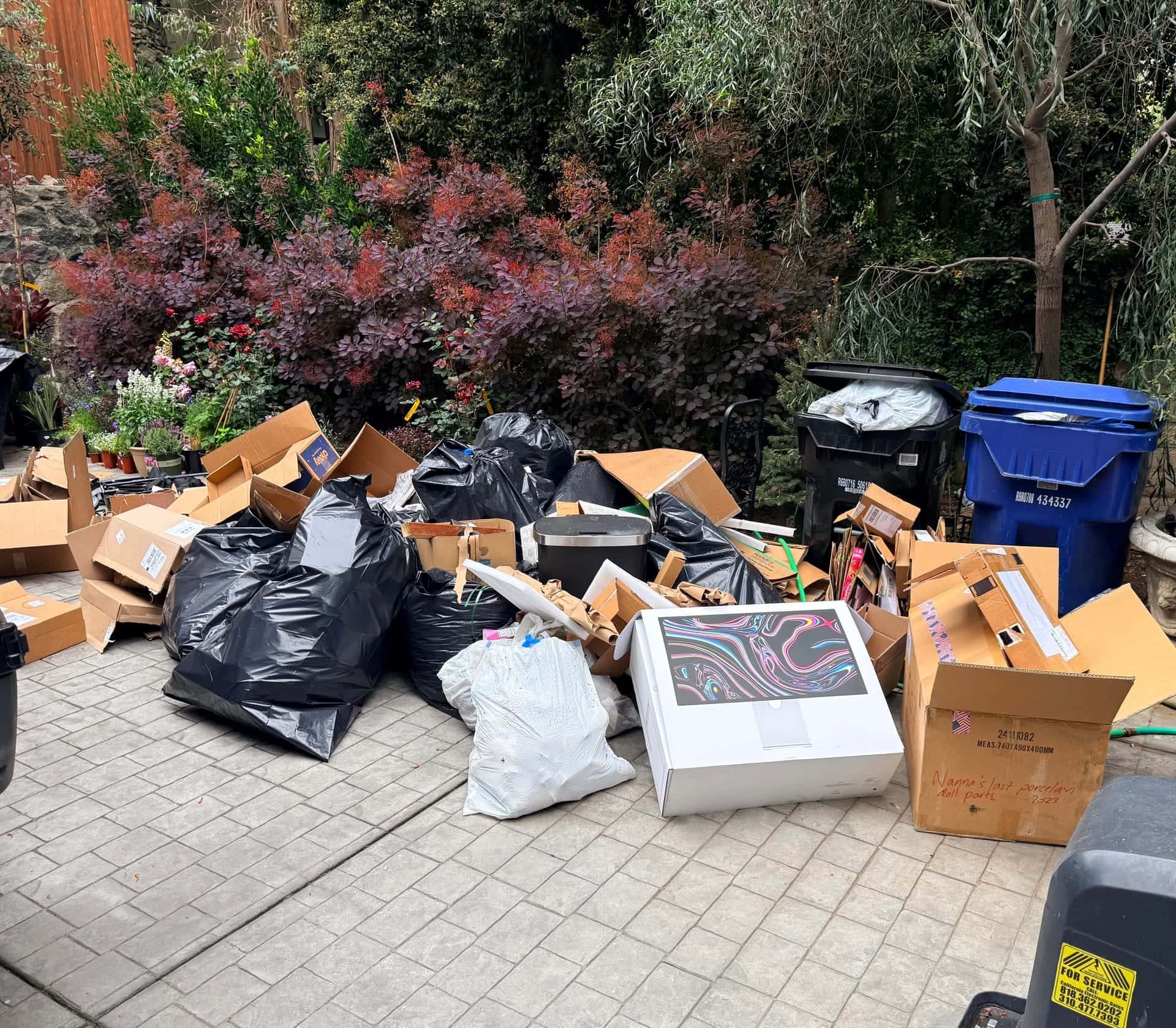
A good crew should follow your lead on what stays and what goes, work at the pace you set, and leave the keep areas alone. We're a family-run crew based in North Hollywood and we work across the Valley, Glendale and Burbank. Text us photos of the rooms and the entrance and we'll send back a price. This customer hired us for their mother's apartment in Glendale.
Contacted Legacy Junk Removal to clean out my elderly mother's apartment (hoarder situation) in Glendale, CA. They arrived on time and was finished within 2 1/2 hours. They did an extraordinary and thorough job! Highly recommend!