
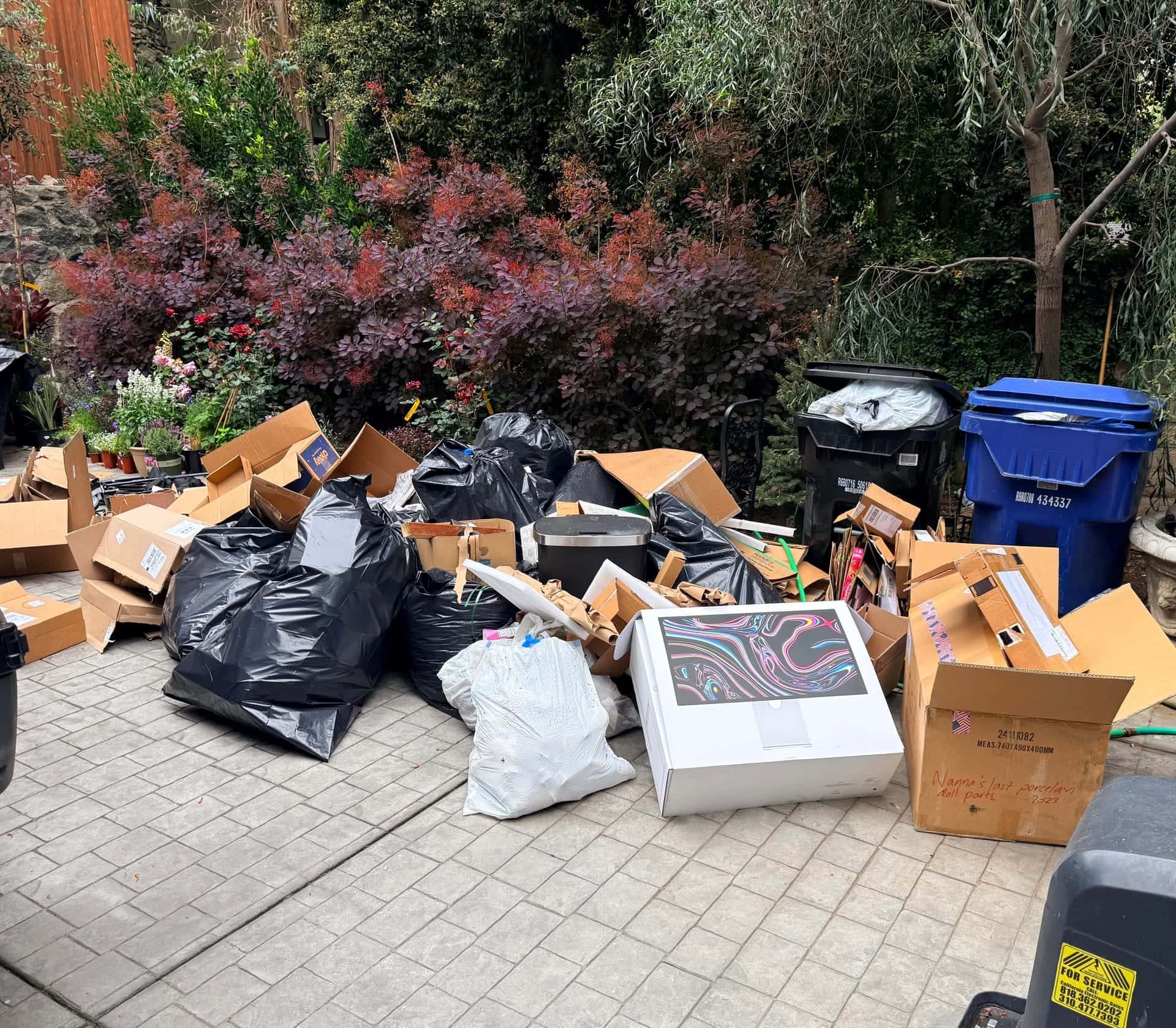
A garage cleanout goes wrong in one of two ways: everything comes out and then goes back in, or it all ends up in one pile that nobody can legally throw away. This planner fixes both. It gives you a layout, a list of what needs a special trip, and a way to decide what's worth a city pickup and what's worth paying to have hauled.
Set up four zones before you pull anything out
Use the driveway, a tarp or painter's tape to mark four areas. Everything that leaves the garage goes into one of them, the first time you touch it.
| Zone | What goes here | Where it ends up |
|---|---|---|
| 1. Keep | Things you've used in the last year or truly need | Back into the garage, onto shelves, last |
| 2. Donate or sell | Working tools, bikes, sports gear, furniture in good shape | A charity drop-off or pickup, or a listing |
| 3. Hazardous and recycling | Paint, oil, batteries, chemicals, propane, electronics, scrap metal | S.A.F.E. Center, PaintCare, a used-oil center or a scrap yard |
| 4. Haul away | Broken furniture, worn-out gear, old boxes, general junk | City bulky pickup, your bins, or a hauler |
A few ground rules make the zones work:
- Keep zone 3 in a separate, shaded spot. Chemicals shouldn't bake in the sun or sit where kids and pets can reach them.
- Don't let zone 1 grow back. If it wasn't used in a year and it isn't sentimental, it probably belongs in zone 2 or 4.
- Put zone 4 closest to the street. That's where a truck or the city crew will pick up from.
The hazardous shelf: paint, oil, batteries and propane
This is the part of a garage cleanout most people get wrong, and it's the part the law cares about. California makes it illegal to put hazardous waste in the garbage, down storm drains or on the ground.[1]
Paint and stains
Even dried paint can't go in the trash in California.[2] PaintCare runs free drop-off sites across the state.[3] They take latex and oil-based house paint, primers, sealers, stains and varnishes,[4] as long as the paint is in its original container of 5 gallons or less, with the label on and the lid secured.[5] Every site takes at least 5 gallons per visit; call ahead if you have more.[2]
PaintCare won't take aerosol spray paint, thinners and solvents, auto paint, caulk, glue or roof patch.[5] Take that group to a S.A.F.E. Center instead.
Motor oil, filters and antifreeze
Motor oil, oil filters, antifreeze and car batteries are all banned from the trash.[1] Drain oil into a clean container and don't mix it with anything, not even water.[6] CalRecycle has certified more than 3,000 used-oil collection centers that take oil from the public.[6]
Batteries, bulbs and propane
All batteries, from AAs to car batteries, are banned from the trash, recycling and organics bins.[1] So are fluorescent tubes,[1] and propane cylinders from grills and camp stoves.[1] Tape the terminals of lithium and e-bike batteries if you can.[7]
Pesticides, pool chemicals and treated wood
Pesticides, herbicides, pool chemicals, solvents and cleaners go to a household hazardous waste facility.[1] Chemically treated wood, like old fence posts and railroad ties, is also managed as hazardous waste.[1]
Taking it to a S.A.F.E. Center
S.A.F.E. stands for Solvents, Automotive, Flammables and Electronics, and the centers are free for LA residents.[7] They take aerosol cans, auto fluids, cleaners, fluorescent bulbs, paint, pesticides, pool chemicals, propane cylinders, batteries, motor oil and electronics.[7]
| Center | Address | Open |
|---|---|---|
| East Valley (Randall Street) | 11025 Randall Street, Sun Valley 91352[8] | Sat and Sun, 9 a.m. to 3 p.m.[8] |
| North Valley (Nicole Bernson) | 10241 N. Balboa Blvd., Northridge 91325[9] | Sat and Sun, 9 a.m. to 3 p.m.[9] |
| Los Angeles–Glendale | 4600 Colorado Blvd., Los Angeles 90039[10] | Saturdays only, 9 a.m. to 3 p.m.; state photo ID required[10] |
Packing the car for a S.A.F.E. trip
- Keep each product in its original container, lid tight, standing upright.
- Load it in the trunk, not the back seat.
- Stay under 15 gallons or 125 pounds for the trip.
- Be ready to give the address the waste came from.
- Stay in the car with the engine off; staff unload it for you.
- Check the weather: centers may close or change hours in bad weather.
Those limits and rules come from LA Sanitation.[7],[8] Burbank residents can also take batteries, bulbs, antifreeze and electronics to the Burbank Recycle Center's Drop Zone at 500 S. Flower St.,[11] which doesn't take motor oil, paint or chemicals.[11] Glendale runs its own HHW facility at 780 Flower St. for Glendale and La Cañada residents.[12]
Tools, bikes and gear: donate or sell
Garages are full of things that work fine and just aren't used anymore. Pull those out first, because they have somewhere better to go than a landfill.
- Out of the Closet accepts tools, electronics, appliances, kitchenware and select furniture.[13] Its North Hollywood thrift store is at 6241 Laurel Canyon Blvd.[14]
- Goodwill Southern California accepts anything with a battery or a plug, in any condition.[15] It won't take cribs, car seats, strollers or high chairs.[16]
- Habitat for Humanity LA ReStores take furniture with no broken or missing pieces and working appliances less than 8 years old.[17]
- Pickup Please collects small donations, but only items one person can easily lift.[18]
For electronics, CalRecycle's order of advice is to reduce, reuse by donating or selling what still works, and recycle the rest.[19]
Metal, old appliances and tires
Old fridges and freezers. In the City of LA, LASAN picks up large metal appliances for free for homes with its curbside service: fridges, freezers, washers, dryers and water heaters. Book a business day before trash day and take the fridge or freezer doors off.[20]
Scrap metal. SA Recycling's yard at 8250 Tujunga Ave in Sun Valley is open weekdays 7 a.m. to 4 p.m. and Saturdays until noon.[21] Its Sun Valley yards take large appliances but not propane tanks, oil, fuel or antifreeze,[21] and you'll need a government photo ID to sell.[21]
Tires. Tires are banned from the trash in California.[1] City of LA residents can drop off up to 4 tires per calendar year, without rims, at a LASAN yard, with a state photo ID and a current utility bill. The Valley yards are 11050 Pendleton Street in Sun Valley and 8840 Vanalden Avenue in Northridge, weekdays 8 a.m. to 1 p.m.[22]
Leftover lumber, tile and yard debris
Half-used bags of concrete, extra tile and old drywall aren't bulky items. LA Sanitation won't pick up construction materials like concrete, bricks or dirt at the curb.[23] Burbank's bulky pickup excludes them too, and points residents to its 2-yard rental bin instead.[24] For a real pile of remodel leftovers, see the construction debris guide.
Branches and trimmings go in the green bin in the City of LA.[25] For a bigger pile, LASAN-serviced homes get one free brush pickup a year, with bundles tied and no longer than 4 feet or heavier than 30 pounds.[26]
City bulky pickup or a hauler?
For zone 4, the choice usually comes down to time and how much you want to carry.
| City bulky pickup | Paying a hauler | |
|---|---|---|
| City of LA | Free, no set limit, for 1 to 4 unit homes LASAN services; on trash day with a business day's notice[23] | Any day the schedule allows; they load from the garage |
| Burbank | Free for most furniture; appliances, lawnmowers, leaf blowers and tires carry a per-item Special Handling Fee[24] | Same |
| Glendale (1 to 4 units) | Book three business days ahead; only items on the City's list[27],[28] | Same |
| Pasadena | Two free pickups a year, about 3 cubic yards each[29],[30] | Same |
| Bags and boxes of trash | Not part of bulky pickup in Burbank[24] | Included in the load |
The City is the better deal when you can wait for trash day, the items are big and few, and you can get them to the curb. A hauler is the better deal when the garage is full of small, mixed things, or when you want it all gone this weekend.
A one-weekend plan
Saturday morning. Pull everything out into the four zones. Put the hazardous zone in the shade. Take photos of anything to sell.
Saturday afternoon. Load the car with donations and drop them off. Pack the hazardous zone for a S.A.F.E. trip.
Sunday morning. S.A.F.E. Center run, before the 3 p.m. close.
Sunday afternoon. Put the keep zone back, with shelves and labels. Book the city pickup, or have the haul-away zone picked up.
When to call a hauler
Some garages are one weekend of work. Others are ten years of it. A hauler makes sense when:
- zone 4 is bigger than a pickup truck load, or mostly small mixed items;
- you've got heavy things like an old freezer, a treadmill or a workbench;
- you've already sorted, and you just want the rest gone before the next trash day;
- the garage is detached and down a long driveway or alley;
- you'd rather spend Sunday putting shelves up than driving to the dump.
We're a family-run crew from North Hollywood, and we clear garages across the Valley, Burbank and Pasadena. Send photos of the garage and we'll text back a price. Same-day service most days when you reach us by early afternoon; next-morning slots are common. For the chemical shelf: We don't take paint, chemicals (like motor oil and solvents), tires, asbestos, medical waste, ammunition or propane tanks, empty or full. We'll point you to the right drop-off. Settle that part before the day, so nothing on the shelf is a surprise.
Brian and Carlos were fantastic in removing unwanted items from our garage in Pasadena. Quick, courteous communication, easy scheduling, and efficient service. We will be using them again for sure!