
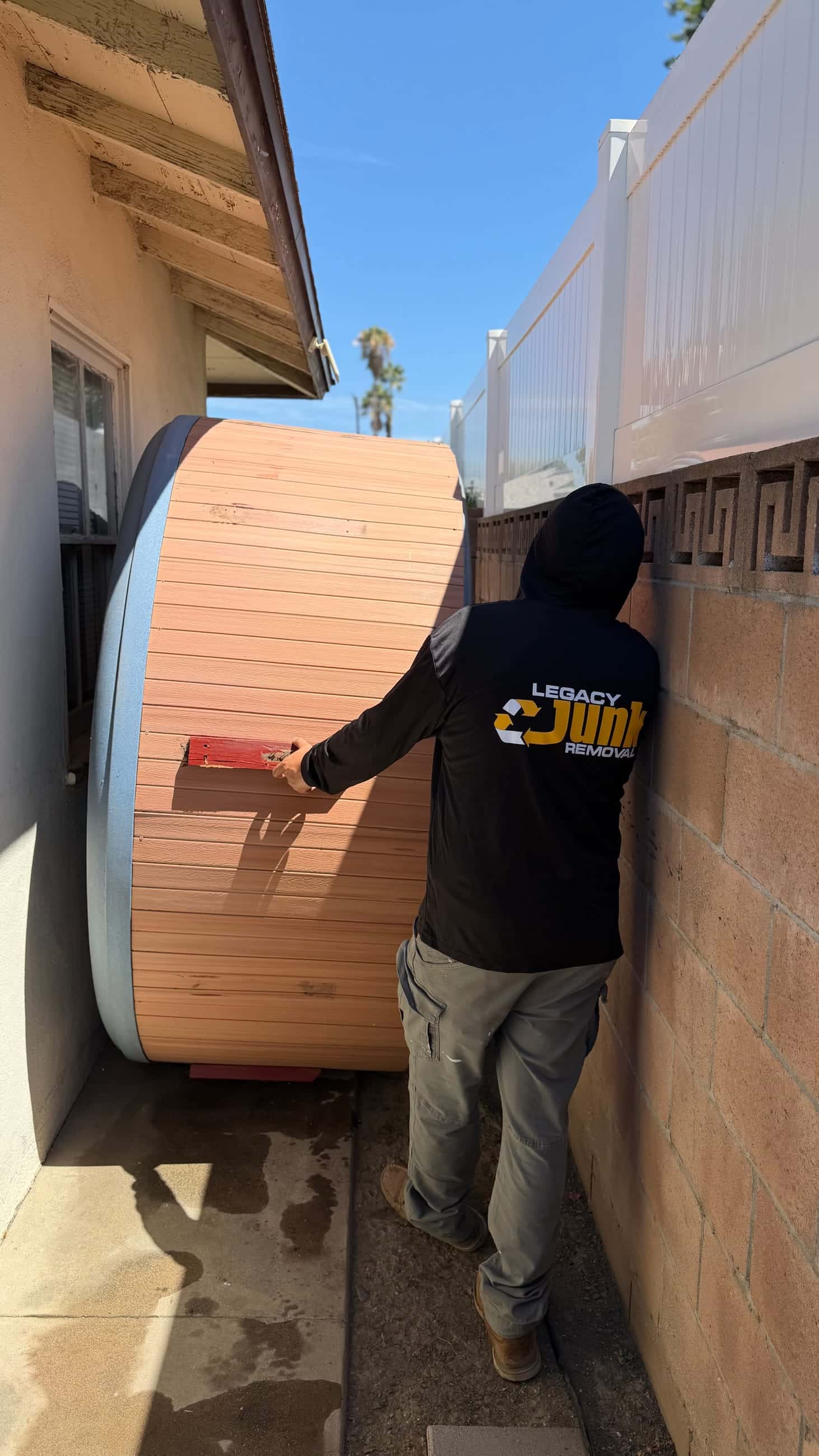
A hot tub on a flat patio next to the driveway is one kind of job. A spa sitting on a terrace at the bottom of a flight of outdoor stairs is a different one. This post explains how we handle the second kind, and every job detail below comes from what customers wrote in their reviews, not from a story we made up.
Why a hillside spa is harder than it looks
A four-person spa doesn't fit through a side gate in one piece, and it certainly doesn't go up a narrow set of garden steps. On a hillside lot, the path from the yard to the street is usually the whole job: stairs, tight turns, retaining walls, and sometimes a neighbor's side yard.
The hills around the Valley are full of lots like that. Encino and Tarzana each have flats north of Ventura Boulevard and hills to the south.[1] LA's Hollywood community plan area takes in what City Planning calls "various hillside communities."[2]
Here's how one customer described the kind of job this post is about:
Ricardo and Brian did an amazing job helping us out with a difficult removal of a spa from our yard that involved a lot of outdoor stairs. Legacy scheduled us the next morning when they saw we were in need of immediate assistance after another team was unable to complete the job and had to stop half way. Legacy really got us out of a pinch when we needed it most and we are very grateful for them. Thanks very much to all the Legacy team! We will definitely call them again if we need this type of service in the future.
That's the whole problem in a few lines: lots of outdoor stairs, and a previous attempt that stopped partway through.
Step 1: The spa gets drained, the right way
Drain it if you can; if not, tell us and we'll plan for it. Most spas have a drain valve near the base, and a garden hose or a submersible pump speeds things up.
Where that water goes matters. LA County Public Works advises letting the chemicals dissipate before draining a pool or spa, not draining within 5 days of adding chemicals, and never backwashing a filter into the street or storm drain.[3] The reason is simple: storm drains carry runoff to creeks and the ocean with no treatment.[3] On a slope, water also finds its own way downhill, so think about where it'll end up before you open the valve.
Step 2: The power is off
Power must be off before we arrive. If your spa is hardwired, have an electrician disconnect it first. A plug-in spa usually just needs its breaker switched off; if you're not sure which kind you have, send a photo of where the cord or conduit meets the house.
Step 3: Cutting it down to carry size
This is the step that makes hillside removal possible. Instead of trying to move the spa whole, the crew cuts the shell and the cabinet into sections small enough to fit through side gates, down steps and around corners. One customer summed up that part of their job like this:
Ricardo and his team were very professional and very prompt in removing my old spa at a very reasonable cost. They chopped the shell into small parts and quickly carted them away. They even finished by sweeping up the remaining debris. Highly recommend them for your junk removal.
Once the spa is in pieces, the heavy lifting becomes a series of manageable carries instead of one impossible one.
Step 4: Carrying it up (or down) to the truck
With a hillside yard, the carry is where the time goes. Each section goes by hand along the path to the street, up or down the outdoor stairs, until it's all loaded. Speed depends on the spa and the route, but a straightforward job can move fast. Kim E. wrote on Google that the crew "got loaded a 4 seater spa and double refrigerator in under an hour" on their visit.
Step 5: Sweeping up
When the last piece is loaded, the crew clears the debris and sweeps the pad or deck, so all that's left is the spot where the spa sat. That last step shows up in reviews too. Rich M. wrote on Google that the crew "Removed my old spa and left everything clean."
Hillside streets have their own parking rules
Getting a truck close to a hillside home is part of the job, and the City has rules that can affect when it's possible:
- On LAFD-declared Red Flag days, parking is banned on posted streets in Very High Fire Hazard Severity Zones, including narrow roads and sharp curves, and illegally parked vehicles are towed.[4] LAFD says those days average 4 to 7 a year.[4]
- Posted street-sweeping routes are swept every other week, and cars parked there on sweeping days are cited.[5]
- In Pasadena's posted Red Flag areas, licensed home-maintenance contractors may park at the job address for up to 60 minutes, only while the driver is there.[6]
If a Red Flag day lands on your removal date, it's worth talking about moving the job rather than risking a tow on a narrow street.
What you can do before we come
Before hot tub removal day
- Drain the spa, following the County's timing on chemicals.
- Switch the power off at the breaker.
- Take one photo of the spa and one of the path to the street, including every step and gate.
- Unlock side gates and move pots, hoses and furniture off the route.
- Let neighbors know if the crew will need to pass through a shared side yard.
- Decide whether the cover, steps and any deck or surround should go too.
What it costs, and how to get a price
Price depends on the size of the spa and how hard the carry is. A four-seater beside the driveway is not the same job as one at the bottom of a hillside stairway, so the photos of the path matter as much as the photo of the spa. Send both and we'll text you an exact number before we schedule. Above-ground spas, covers, steps and cover lifters are all part of what we take. In-ground spas: send photos and we'll tell you what's possible.
For the full service details, see our hot tub removal page. If you're weighing other options, like selling it or taking it apart yourself, our guide to getting rid of a hot tub in LA covers those too. There's also our earlier post on hot tub removal cost, time and what to do first.